
Ah, the thesis. It’s the culmination of your academic journey, a chance to show what you’ve learned, and perhaps, your passport to a brighter future. For international students, it’s also a daunting prospect. You’re not just tackling a complex research project, you’re doing it in a different language, within a different academic culture, and maybe even a different country. Australians have their own way of doing things, and that includes thesis writing. What might have been acceptable in your home country might not fly here. This can lead to a few common pitfalls. But fear not, we’re here to help you navigate this complex terrain. Let’s explore the seven most common mistakes international students make in their Australian thesis and how you can avoid them.
1. Lack of Clarity and Structure
A thesis isn’t just a collection of facts and theories. It’s a structured argument, and that means clarity and organisation are paramount. Many international students struggle with this. They might present information in a haphazard way, failing to follow a logical flow. This can make the thesis difficult to understand, and even harder to grade.
How to avoid it:
- Plan meticulously: Start by creating a detailed outline of your thesis. This should include your research questions, your methodology, your findings, and your conclusions.
- Use headings and subheadings: This will help you to break down your thesis into manageable chunks and make it easier to navigate.
- Employ transition words: These help to link your paragraphs and sections together, creating a smooth flow of ideas.
- Proofread, proofread, proofread: Make sure your thesis is free from any grammatical errors or awkward phrasing.
- Seek assignment help: If you’re struggling to structure your thesis, consider seeking professional assignment help. They can provide you with guidance and support, helping you to create a well-structured and logical document.
2. Inadequate Literature Review
A literature review is not just a summary of what’s been written before. It’s a critical analysis of the existing research in your field. It should demonstrate your understanding of the relevant theories and concepts, and identify any gaps in the literature that your research will address. Many international students make the mistake of simply summarizing the existing research, without providing any critical analysis.
How to avoid it:
- Be critical: Don’t just accept what you read at face value. Evaluate the strengths and weaknesses of each study, and consider how it contributes to your overall understanding of the topic.
- Synthesise the literature: Look for connections and patterns across different studies. This will help you to create a cohesive and well-argued literature review.
- Identify gaps in the research: This is the most important part of your literature review. Explain why your research is necessary and how it will contribute to the existing knowledge base.
3. Poor Methodology
Your methodology is the heart of your thesis. It describes how you went about your research and how you arrived at your conclusions. If your methodology is flawed, then your entire thesis is called into question. Many international students struggle with this. They might not clearly define their research questions, or they might not use the appropriate research methods.
How to avoid it:
- Clearly define your research questions: Your research questions should be specific, measurable, achievable, relevant, and time-bound (SMART).
- Choose the right research methods: Make sure your research methods are appropriate for your research questions. Consider factors such as the nature of your data, the size of your sample, and your available resources.
- Explain your methodology clearly: Your methodology should be described in sufficient detail so that other researchers can replicate your study.
4. Insufficient Data Analysis
Data analysis is the process of interpreting your research findings. This is where you make sense of the data you’ve collected and draw conclusions. Many international students struggle with this. They might not use the appropriate statistical methods, or they might not present their findings clearly.
How to avoid it:
- Use appropriate statistical methods: Make sure you use the appropriate statistical methods to analyse your data. Consult with a statistician if you’re not sure which methods to use.
- Present your findings clearly: Use tables, charts, and graphs to present your findings clearly and concisely.
- Interpret your findings carefully: Don’t jump to conclusions. Carefully consider your findings in the context of your research questions and the existing literature.
5. Weak Discussion and Conclusion
The discussion and conclusion are your chance to synthesis your findings and present your overall argument. This is where you explain the significance of your research and identify any limitations. Many international students struggle with this. They might simply restate their findings, without providing any synthesis or analysis.
How to avoid it:
- Synthesise your findings: Connect your findings to your research questions and the existing literature.
- Explain the significance of your research: Why is your research important? What are the implications of your findings for your field?
- Identify limitations: Every study has limitations. Be honest about yours and explain how they might have affected your findings.
- Offer recommendations for future research: What are the logical next steps for research in your field?
6. Incorrect Referencing
Referencing is an essential part of academic writing. It demonstrates that you’ve done your research and that you’re acknowledging the work of others. It also helps readers to locate the sources you’ve used. Many international students struggle with this. They might use the wrong referencing style, or they might not reference consistently.
How to avoid it:
- Use the correct referencing style: Make sure you use the referencing style that’s required by your university. Common styles in Australia include APA, Harvard, and MLA.
- Reference consistently: Once you’ve chosen a referencing style, use it consistently throughout your thesis.
- Use referencing software: There are many referencing software programs available that can help you to manage your references and create a bibliography. Examples include EndNote, Zotero, and Mendeley.
7. Poor Time Management
Thesis writing is a marathon, not a sprint. It takes time, effort, and dedication. Many international students struggle with this. They might underestimate the amount of time it takes to complete a thesis, or they might leave everything until the last minute.
How to avoid it:
- Create a realistic timeline: Break down your thesis into smaller, manageable tasks and assign a deadline to each task.
- Stick to your timeline: Discipline yourself to stick to your timeline, even when you’re feeling unmotivated.
- Take breaks: Don’t try to do everything at once. Take regular breaks to rest and recharge.
- Ask for help: If you’re struggling to manage your time, talk to your supervisor or a university counsellor.
We recommend checking out this helpful resource on chcprp003 assessment answers for additional support with related academic tasks. This can be especially useful if your thesis involves elements related to this competency unit.
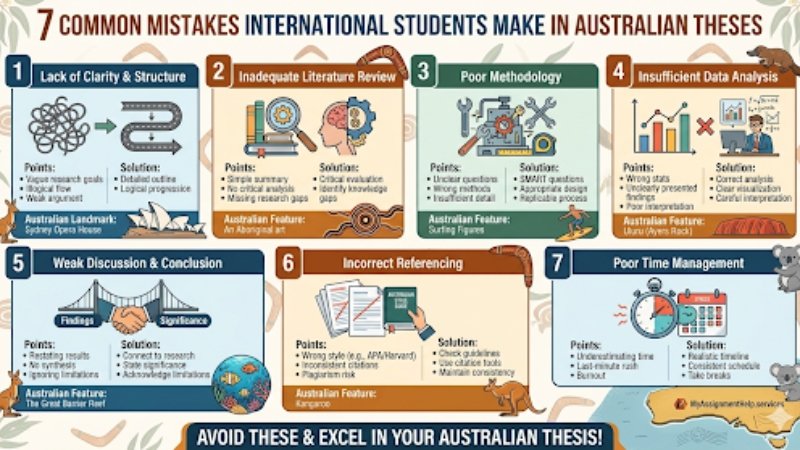
Key Takeaways
To ensure your Australian thesis stands up to rigorous academic standards, keep these essential strategies in mind:
- Prioritize Logical Flow: A high-quality thesis relies on a meticulous plan. Use a detailed outline and clear signposting (headings and transitions) to ensure your argument progresses logically from one section to the next.
- Move Beyond Summary: Your literature review must be a critical evaluation, not just a list of sources. Focus on identifying specific “knowledge gaps” that your unique research aims to fill.
- Ensure Methodological Rigor: Clearly define SMART research questions and select methodologies that are directly appropriate for your data. Transparency is key—other researchers should be able to replicate your process.
- Visualize Your Data: Don’t let your findings get lost in text. Use clear charts and tables, and ensure your statistical analysis is accurate and interpreted within the broader context of your field.
- Synthesize, Don’t Just Repeat: Use your discussion and conclusion to explain the “so what?” of your research. Acknowledge your study’s limitations while highlighting its practical or theoretical significance.
- Master Australian Referencing: Consistency is vital. Whether your university requires APA, Harvard, or MLA, use dedicated referencing software to manage citations and avoid accidental plagiarism.
- Manage Your Energy, Not Just Time: Build a realistic timeline that accounts for inevitable delays. Breaking the project into smaller milestones and taking regular breaks will help you avoid the common trap of the “last-minute rush.”
FAQ
Q: How can I find good sources for my thesis?
A: Talk to your university librarian. They can help you to search online databases, locate relevant books and articles, and identify other useful resources.
Q: How can I improve my academic writing skills?
A: Read academic papers in your field to familiarise yourself with the style. Utilise your university’s academic writing support services. Practice writing and ask for feedback from your supervisor or peers.
Q: How important is my supervisor in the thesis process?
A: Extremely important. Your supervisor is your guide and mentor. They can provide valuable feedback on your research, help you to overcome any challenges you encounter, and ensure that your thesis meets the required standards. Maintain regular contact and be proactive in seeking their advice.
Q: What should I do if I feel overwhelmed by my thesis?
A: Take a break. Step away from your work and do something completely different. This can help you to clear your head and come back to your thesis with fresh perspective. Don’t hesitate to seek support from university wellbeing services if you’re struggling.
References
Dawe, L., Stevens, J., Hoffman, B., & Quilty, M. (2021). Citation and Referencing Support at an Academic Library: Exploring Student and Faculty Perspectives on Authority and Effectiveness. College & Research Libraries, 82(7), 991. https://doi.org/10.5860/crl.82.7.991 Cited by: 22
Efron, N. (2024). Ten tips for writing a brilliant PhD thesis – and enjoying the process. Clinical and Experimental Optometry, 1–3. https://doi.org/10.1080/08164622.2024.2413706 Cited by: 0
Golding, C. (2017). Advice for writing a thesis (based on what examiners do). Open Review of Educational Research, 4(1), 46–60. https://doi.org/10.1080/23265507.2017.1300862 Cited by: 31
Paltridge, B., & Starfield, S. (2020). Thesis and Dissertation Writing in a Second Language: A Handbook for Supervisors. Psychology Teaching Review, 26(1), 107–108. https://doi.org/10.53841/bpsptr.2020.26.1.107 Cited by: 199
Author Bio
This blog post was written by Mark , educator at MyAssignmentHelp, a leading provider of academic assistance. They are dedicated to helping students succeed in their studies and achieve their academic goals.