
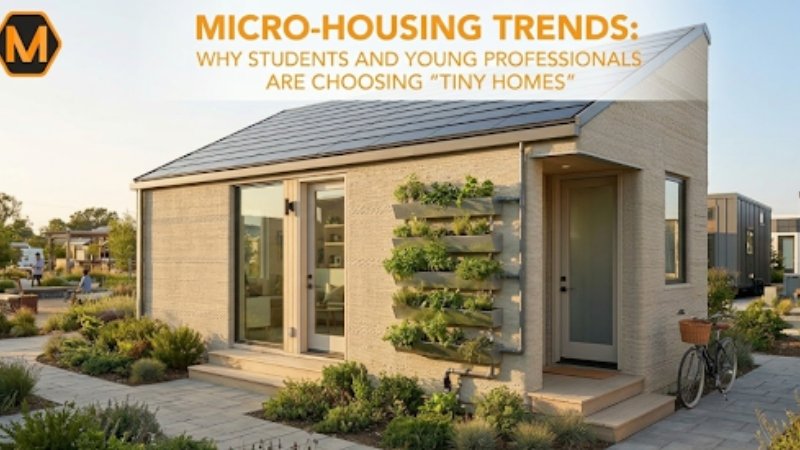
The year 2026 has seen a fundamental shift in the global housing market. For decades, the measure of success was the square footage of one’s home, but a new generation is flipping the script. Micro-housing—dwellings typically ranging from 200 to 400 square feet—has moved from a fringe lifestyle choice to a sophisticated urban solution. Whether it is a modular pod in a bustling city centre or a “Tiny House on Wheels” (THOW) parked in a sustainable village, these homes represent a response to the converging crises of housing affordability and environmental sustainability.
The appeal of this movement is particularly strong among university students who are tired of the revolving door of overpriced dormitories and shared apartments. For a student, a tiny home offers more than just a place to sleep; it provides a curated environment designed for deep focus and autonomy. However, transitioning into such a compact lifestyle while maintaining a full academic load can be a logistical puzzle. Many students find that while they can manage their small space easily, they often need coursework help from professional services like myassignmenthelp to stay on top of their rigorous grading rubrics while adapting to a minimalist lifestyle. This balance of physical simplicity and academic support allows young residents to thrive without the typical burnout associated with university life.
The Financial Evolution: Ownership vs. Renting
The primary driver of the micro-housing trend in 2026 is financial literacy. In major metropolitan areas, young professionals often spend upwards of 45% of their income on rent—money that offers zero return on investment. Tiny homes, often costing between $35,000 and $75,000, present a rare opportunity for debt-free homeownership.
| Feature | Traditional Apartment (Urban) | Micro-Housing / Tiny Home |
| Average Monthly Cost | $2,200 – $3,500 (Rent) | $400 – $800 (Utilities + Land) |
| Ownership Status | Tenant (Zero Equity) | Owner (Full Equity) |
| Utility Efficiency | Low (High wasted space) | High (Optimized systems) |
| Mobility | Fixed (Lease-bound) | High (If on wheels/modular) |
Designing for 2026: The “Transformer” Home
What makes micro-housing viable today is the rapid advancement in “PropTech” (property technology). In 2026, tiny homes are no longer just “small houses”; they are high-tech, multifunctional machines. We are seeing the mainstream use of kinetic furniture—walls that move on motorised tracks to reveal a home office during the day and a dining room at night.
Common Space-Saving Innovations:
- Retractable Ceilings: Beds that lift into the ceiling cavity to free up floor space.
- Integrated Smart Glass: Windows that switch from transparent to opaque for privacy without the need for bulky curtains.
- Compact HVAC: Energy-efficient climate systems that utilise AI to predict and manage heat based on the resident’s schedule.
[Diagram Suggestion: Imagine a cross-section of a 250 sq. ft. unit showing a “Dual-Zone” layout. Zone A is the “Active Zone” (kitchen/office), and Zone B is the “Quiet Zone” (sleeping loft). The center features a “Service Core” containing the bathroom and plumbing.
The Sociological Impact on Young Professionals
Beyond the individual benefits, social scientists are closely monitoring how micro-housing affects the broader community. There is a growing body of research suggesting that smaller private spaces lead to more vibrant public spaces. When your living room is small, you are more likely to spend time in local parks, cafes, and community gardens. This shift is a frequent topic in university lecture halls, where students studying human behavior often seek social science assignment help to better understand how urban density impacts mental health and social cohesion.
Sustainability: The Eco-Friendly Choice
Environmental impact is no longer an afterthought for the 2026 homeowner; it is a prerequisite. Tiny homes have a naturally smaller carbon footprint, requiring fewer building materials and significantly less energy to heat and cool.
- Energy Independence: Many micro-homes are now built “off-grid ready” with integrated solar roofing and Tesla-style battery walls.
- Water Conservation: Greywater recycling systems are becoming standard, allowing residents to reuse shower water for their vertical gardens.
- Material Sourcing: The 2026 trend favors reclaimed timber and 3D-printed components made from recycled ocean plastics.
Navigating the Legal Landscape
One of the biggest hurdles to the micro-housing movement has always been zoning laws. However, 2026 has brought significant legislative progress. Many states have adopted “Accessory Dwelling Unit” (ADU) laws that allow homeowners to place tiny homes in their backyards legally. This has created a new “missing middle” in housing—providing affordable options for students who can live in a self-contained unit behind a family member’s home or a rented backyard space.
The Psychological Benefit of Minimalism
Living in a micro-home requires a radical shift in mindset. You cannot be a “hoarder” in 300 square feet. This forced minimalism often leads to decreased anxiety and increased mental clarity. By removing the physical clutter of unnecessary possessions, young professionals report feeling more “agile” in their careers. They are not tethered to a specific location by a house full of furniture, allowing them to follow job opportunities across the globe with nothing more than a suitcase.
Conclusion: A Permanent Shift in Urban Living
As we look forward, it is clear that micro-housing is not a temporary fad but a structural change in how we perceive property. For the student tackling a difficult degree or the young professional launching a new business, the tiny home offers a launchpad that is financially sound and environmentally responsible. By choosing to live smaller, they are actually living larger—freeing up the time, money, and mental energy to focus on what truly matters in 2026: experience, community, and personal growth.
Frequently Asked Questions
Is it difficult to get legal permission to live in a micro-home?
Zoning laws vary by location, but many regions are updating regulations to allow these units as “Accessory Dwelling Units” (ADUs) in residential backyards or specialized tiny home communities. Always check your local municipal codes regarding minimum square footage and permanent foundation requirements.
How do these compact homes handle extreme weather or insulation?
Modern small-scale housing utilizes advanced spray-foam insulation and high-efficiency HVAC systems that outperform traditional builds. Because the volume of air is much smaller, these homes can be heated or cooled to a comfortable temperature in a fraction of the time using minimal energy.
Can a micro-apartment really accommodate a full-time remote work setup?
Yes, through the use of multifunctional furniture. Many designs feature “flip-down” desks or hidden workstations that integrate into the living area, allowing residents to maintain a professional office environment during the day that can be tucked away to reclaim living space in the evening.
What happens to the resale value of a tiny home over time?
While traditional real estate usually appreciates, the value of a micro-home depends on its type. Units built on permanent foundations often appreciate alongside the land, while mobile versions may depreciate like a high-end vehicle. However, their high rental demand often provides an excellent return on investment through monthly income.
About The Author
Thomas Taylor is a dedicated content strategist at myassignmenthelp, specializing in the intersection of urban lifestyle trends and student productivity. With a keen eye for modern housing solutions, Thomas explores how environmental design influences personal and professional growth.