
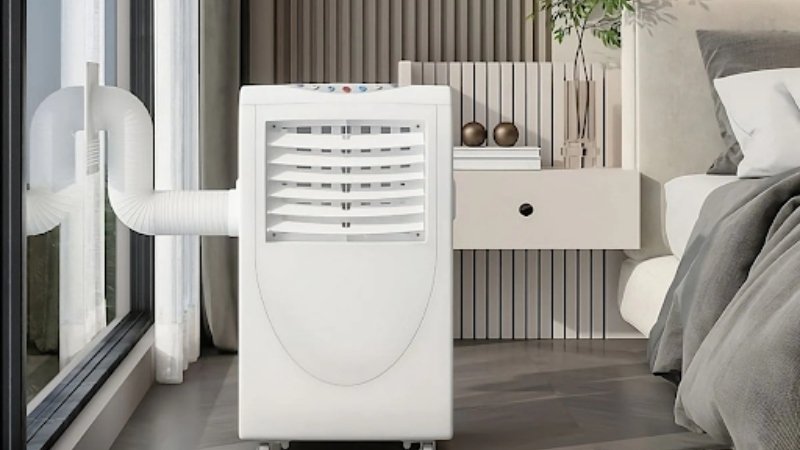
Technically, you can use a portable air conditioner without a window. However, you will need to vent the hot air out somehow. Otherwise, the portable AC will recycle that hot air back into your room and never reach your desired temperature.
In this guide, we discuss how portable ACs work, why venting matters, and how to effectively cool a room without a window.
How Does a Portable Air Conditioner Work?
Portable air conditioners work by drawing warm room air into the AC. They blow that air across cold coils inside the unit. These coils cool the air and send it back into your space. However, they also produce hot exhaust air as a byproduct.
That hot exhaust needs to go somewhere. Ideally, it will vent out of the room you are trying to cool. If it doesn’t, your AC is literally defeating its own purpose. It would be like trying to cool your kitchen by leaving the oven door open.
Venting allows hot air to escape while cool air remains inside. Luckily, venting does NOT always require a window.
Why You Don’t NEED a Window to Vent Your Portable AC
Portable AC manufacturers typically include a window kit with their units. After all, it’s the easiest way to install the machine.
But the window kit doesn’t turn your portable AC into a “window unit.” The kit is merely a way to push that exhaust hose through your window to the outdoors.
A window is simply the most convenient way to vent your portable AC because most rooms have them. You do not NEED a window. You need an exit point.
That opening can be a hole in your wall, door, ceiling, or existing dryer vent. It just needs to allow that hot air to leave the room so your AC can cool it down.
5 Methods to Vent a Portable AC Without a Window

Here are the most common ways to vent without access to a window.
Vent Into a Wall
Cutting a small hole in your wall to vent your portable AC is one of the best permanent solutions. Use a hole saw to create a clean-cut opening in an exterior wall. Install a vent cover over the hole. Connect your exhaust hose to the vent cover, and voila.
This is technically DIY work, but it’s not difficult. You’ll need a drill, hole saw drill attachment, and vent cover. You can always hire a handyman to install it for you. It’s a quick job once you get started, and you’ll never have to move your AC again.
Vent Into a Sliding Door
Good news if you live in a house with sliding glass doors. You can purchase a sliding door vent kit that attaches in the same way as a window kit. The sliding panel attaches to your door track and seals tightly around your hose.
This is as easy as window venting and requires almost no DIY skills. Check the dimensions of your door gap before buying a kit to ensure compatibility. Most sliding vent kits cover a standard range of door heights.
Vent Into a Drop Ceiling
Lots of basements, commercial buildings, and server rooms use drop ceilings. You can vent through one of those ceiling tiles with ease. Pop open the ceiling grid and remove one ceiling tile.
Install an AC vent adapter in place of the ceiling tile. Run your exhaust hose up and through the tile and adapter. Then the hot air will vent into the space above your drop ceiling. This works great if you have a drop ceiling in your space. Make sure there’s adequate airflow in the space above to avoid getting that hot air sucked back into your room.
Vent Into Another Room
If ANOTHER room in your house has a window, you can vent into that room and out their window. Run your hose from your room without a window into the adjoining room. Then vent out of their window using their window kit or hose length.
You may need to purchase a longer hose or hose extender to reach (we’ll cover this option later). Keep in mind this method WILL heat up that other room. So, try to choose a room you don’t mind warming up as a result. Closets, hallways, and utility rooms work well.
Vent Into a Dryer Vent
Speaking of dryer vents. Your dryer vent exists for the same reason we’re discussing venting your portable AC. They both push hot air from the inside of your home to the outside. Some people choose to vent into their dryer vent as a last resort. If you have easy access to your dryer vent, this can work well. But there are downsides to this method.
Dryer vents are notoriously smaller than portable AC exhaust hoses. You may need to purchase an adapter to connect the hose to your vent. Also, do not run your dryer and portable AC at the same time through the same vent. Most consider this method a backup instead of a primary solution.
Can You Use a Vent less Portable AC Instead?
You may have heard of “vent less” air conditioners. These units do not exist. However, there is a product that some manufacturers are marketing as vent less. Vent less portable ACs are actually referring to evaporative coolers. These look like portable AC units but function very differently.
Evaporative coolers push air through water-soaked pads. As the air passes through these wet filters, the water evaporates and cools the air.
It’s important to note that evaporative coolers do NOT ACTUALLY cool the air. Instead, they add moisture to dry air which CAN make you feel cooler. If you live in a dry climate (hello, Arizona/Nevada), evaporative coolers can be a good option. However, if you live in a humid place like Houston or Miami, an evaporative cooler will make your room feel sticky. THAT is not cooling air—it’s adding to your humidity problem.
Stick with a real portable AC unit and solve your venting problem. You’ll have a cooler room in no time.
Cooling Case Study: Windowless Home Office
Client: Home-based worker
Room converted into an office with no windows
Problem: It got too hot to work in my home office during the day. I couldn’t vent my portable AC unit through a window since there wasn’t one. I foolishly ran it for weeks without venting it and barely noticed a difference in temperature.
Solution: We provided integrated ventilation by…
- drilling an access point and installing a through-wall vent kit for a permanent exhaust point.
- hooking the portable AC’s exhaust hose up to the external vent.
- sealing gaps around the vent hole.
- placing the unit near the vent.
- installing a small fan to help push cool air around.
Results: The room cooled from 29°C to 23°C in about 90 minutes.
Enjoyed cooling off reliably all day.
Don’t have to worry about blowing hot air back into the room.
Moral of the story: Portable air conditioners can function great in rooms without windows. However, venting is still crucial, or the portable AC won’t actually cool your room.
Link: https://www.ducting.com/portable-air-conditioner-vent-window/
FAQs: Windowless Rooms and Portable Air Conditioners
Can you put a portable AC unit in a room without a window?
Yes! However, you will need to vent the hot exhaust air out through another means. Read on to learn about some alternative venting options.
Will a portable air conditioner cool a room if not vented?
No. Portable air conditioning work by pulling hot air out of the room. If that air has nowhere to go, it just comes right back into the room.
What options do I have for venting if I don’t have windows?
There are many alternative venting options for rooms without windows. Some common examples include wall vents, sliding glass doors, drop ceilings, venting into an adjacent room, and dryer vents.
Can I vent through a wall?
Absolutely. Drilling a hole in your wall to accommodate your portable AC’s vent hose is one of the most common and efficient solutions for rooms without windows.
Can I vent into an adjacent room?
Of course. However, be mindful that you’ll be warming up the other room as well. It’s probably not ideal to heat up a bedroom, bathroom, or hallway, so choose a room you don’t mind just a little bit warmer than the rest of your home.
Can I use my dryer vent for my portable AC?
Yes, it can work. However, it is not the ideal solution. You may need to buy an adapter to make the hose fit correctly. Also, you shouldn’t run your dryer while your portable AC is on.
Can I buy a vent less portable air conditioner?
No portable air conditioner exists that doesn’t need to be vented. However, there are products that go by the names “vent less air conditioner” or “pane-less air conditioner.” These are almost always portable evaporative coolers, which function very differently from regular portable AC units.
Are evaporative coolers the same as portable air conditioners?
Not even close. Evaporative coolers add humidity to the air (while portable air conditioners remove humidity). They are ideal for dry climates, but will make a room feel more humid and muggy in places with humid summers.
How else can I cool a room without windows?
Make sure you vent your portable AC properly. Seal gaps where hot air can come back in, keep doors closed, and use fans to help distribute cool air.
Does venting a portable AC without a window require professional installation?
Not always. There are projects that require you to buy professional-grade tools and others where the simplest tool required is a drill. There are also some DIY options and others where we recommend you hire a professional to do the job.
Final Words
Just because you don’t have a window doesn’t mean you’re doomed to suffer all summer. You can use a portable air conditioner without a window as long as you can vent the hot air someplace.
Whether you vent through your wall, door, or dryer vent, make sure that hot air has a place to go. If you set up a proper venting solution for your windowless room, your portable AC will keep you just as cool as any window AC unit would.